Categories
Richardson Writing Initiative

20 Years Ago, We Built the Future Boldly

Innovation happens when you’re willing to take bold, uncomfortable leaps into the unknown.
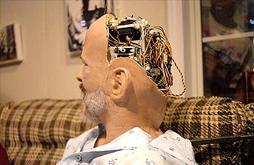
The Philip K. Dick Robot at Wired Magazine Next Fest 2005

Two decades ago, almost to the day, I found myself in the middle of one of the most surreal projects of my career: helping bring to life a robotic version of science fiction legend Philip K. Dick. At the time, I was leading corporate R&D and technology commercialization at the FedEx Institute of Technology and also a graduate student at the University of Memphis, serving as the project manager and fundraiser for an ambitious collaboration between our Institute of Intelligent Systems and David Hanson of Hanson Robotics. Together, we set out to build something that could think, speak, and wonder, just like the man who inspired it.

Our goal was to develop a robot that could hold a real-time, unscripted conversation, powered by early AI that processed hundreds of Philip K. Dick’s interviews and writings to recreate his intellect, humor, and curiosity about reality itself. And it worked. The android could look at you, recognize your face, and respond in Dick’s own words. In 2005, it was science fiction come to life.

That same year, we had the honor of receiving “Robot of the Year” from the American Association of Artificial Intelligence: recognition for a project that pushed the boundaries of what “thinking machines” could do.

A book was later written about our journey: How to Build an Android by David Dufty.

Chapter 4 opens with words I still remember fondly:

“Eric Mathews was something of an oddity of a graduate student.”

Fair enough. I suppose being an “oddity” is part of building boldly.

And of course, as many know, the story took a strange turn worthy of Philip K. Dick himself. The robot’s head was mysteriously lost in transit. One moment it was en route to Google HQ; the next, it was gone without a trace. It was a poetic ending for a project about cracking the mysteries of tech innovation.

Looking back from today’s world, where AI can converse, reason, and assist millions of people daily, it’s incredible to realize how far we’ve come. In 2005, we were experimenting with what might be possible. In 2025, we’re living in the reality we once imagined.

The project taught me something that still drives me: innovation happens when you’re willing to take bold, uncomfortable leaps into the unknown. We didn’t simply build a robot. We helped spark a conversation about what it means to build technology with personality, creativity, and even empathy.

Here’s to building boldly: then, now, and always.

Categories
Startups

The True Value of Entrepreneurial Competitions

As the Entrepreneur-in-Residence at Rhodes College we run competitions to bring together our community to launch new ventures, but often we can lose sight of the true value of the work in the context of competition so I wrote this article to be shared with the campus community there, but it offers important lessons on business and competition generally so I wanted to post it here as well.


Entrepreneurial competitions, like an elevator pitch or venture challenge, are not just contests but milestones in a much larger journey.

Winning is often celebrated as the ultimate success, but it’s essential to understand that it doesn’t predict long-term success in business. Conversely, not winning isn’t a forecast of failure. Many businesses that launch come from individuals who will not clinch a prize.

Competition prizes are limited, but your potential is not.

You are limitless!

The purpose of these events extends beyond the immediate excitement. They are not merely contests, but collective endeavors to advance a multitude of ideas. We leverage these opportunities to help as many people as possible to refine their business ideas, articulate their visions, and network with like-minded individuals and mentors. It’s about creating a rally point where resources, feedback, and energy converge to propel everyone forward together – winning is independent of this and the least important outcome of the competition.

Competitions are objective platforms for growth and learning.

They serve as a practical exercise in the real-world dynamics of business pitching and development, offering a safe environment to experiment, learn, and evolve. Winning or not winning, every participant gains valuable insights into their entrepreneurial capabilities and the potential of their ideas.

We see these events as catalysts, not just for individual projects, but for fostering a vibrant entrepreneurial ecosystem. They are about moving together, leveraging our collective strengths, and helping as many ideas as possible to advance and mature.

Remember, the journey of entrepreneurship is not linear.

It’s a path of constant learning, adapting, and persisting. Whether you’re in the spotlight of victory or not, what truly matters is the resilience to continue, the insights gained, the friends and advisors found, and the relentless pursuit of improvement.

Embrace these competitions as opportunities to rally together, support one another, and drive forward the spirit of innovation.


Why losing a business competition competition is good for your startup. https://techcrunch.com/2009/11/28/winners-curse-why-losing-a-b-school-biz-plan-competition-may-be-good-for-your-startup/