Categories
Richardson Writing Initiative

20 Years Ago, We Built the Future Boldly

Innovation happens when you’re willing to take bold, uncomfortable leaps into the unknown.

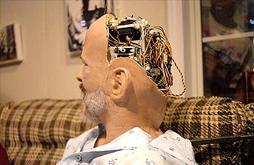
The Philip K. Dick Robot at Wired Magazine Next Fest 2005

Two decades ago, almost to the day, I found myself in the middle of one of the most surreal projects of my career: helping bring to life a robotic version of science fiction legend Philip K. Dick. At the time, I was leading corporate R&D and technology commercialization at the FedEx Institute of Technology and also a graduate student at the University of Memphis, serving as the project manager and fundraiser for an ambitious collaboration between our Institute of Intelligent Systems and David Hanson of Hanson Robotics. Together, we set out to build something that could think, speak, and wonder, just like the man who inspired it.

Our goal was to develop a robot that could hold a real-time, unscripted conversation, powered by early AI that processed hundreds of Philip K. Dick’s interviews and writings to recreate his intellect, humor, and curiosity about reality itself. And it worked. The android could look at you, recognize your face, and respond in Dick’s own words. In 2005, it was science fiction come to life.

That same year, we had the honor of receiving “Robot of the Year” from the American Association of Artificial Intelligence: recognition for a project that pushed the boundaries of what “thinking machines” could do.

A book was later written about our journey: How to Build an Android by David Dufty.

Chapter 4 opens with words I still remember fondly:

“Eric Mathews was something of an oddity of a graduate student.”

Fair enough. I suppose being an “oddity” is part of building boldly.

And of course, as many know, the story took a strange turn worthy of Philip K. Dick himself. The robot’s head was mysteriously lost in transit. One moment it was en route to Google HQ; the next, it was gone without a trace. It was a poetic ending for a project about cracking the mysteries of tech innovation.

Looking back from today’s world, where AI can converse, reason, and assist millions of people daily, it’s incredible to realize how far we’ve come. In 2005, we were experimenting with what might be possible. In 2025, we’re living in the reality we once imagined.

The project taught me something that still drives me: innovation happens when you’re willing to take bold, uncomfortable leaps into the unknown. We didn’t simply build a robot. We helped spark a conversation about what it means to build technology with personality, creativity, and even empathy.

Here’s to building boldly: then, now, and always.

Categories
Richardson Writing Initiative

Guest Post: The Pit Stop Principle

This guest post by my apprentice, Jaron Richardson, reflects on his Summer 2025 journey of entrepreneurial growth and personal transformation.
He shares how building systems, discipline, and purpose turned a season of challenge into a blueprint for sustainable success.

A Summer of Entrepreneurial Transformation

This wasn’t just a summer internship. It was a blueprint for how to live, build, and endure. Under the mentorship of Eric Mathews, CEO of Start Co., what began as an exploration into the mechanics of startups became a masterclass in becoming. I learned to build systems for sustainable success, align personal health with professional growth, and redefine entrepreneurship as a lifestyle rooted in strategic execution rather than perpetual hustle.

Entrepreneurship didn’t just teach me how to create. It taught me how to operate.

Racing Through Life: The Pit Stop Principle

Picture life not as a straight highway but as a high-speed race. Some enter the race with finely tuned machines: privilege, pedigree, access. Others build from the ground up, bolt by bolt. But the key to enduring the race isn’t about horsepower. It’s about how often you enter the pit.

The winners aren’t those who floor the gas until the engine blows. They’re the ones who master their rhythm, who know when to pull off, refuel, recalibrate, realign. They trust their systems and invest in their crew.

My pit stop wasn’t scheduled. It came in the form of pneumonia, a three-week battle that forced me off the track. But it didn’t derail the mission. It clarified it. I had ignored the warning signs, convinced that burnout was a badge of honor. It wasn’t. It was a signal that I needed a system, not a sprint.

Lessons from the Pit: Principles of Sustainable Entrepreneurship

1. Entrepreneurship Redefined
“Seventeen percent of something real is better than 100 percent of something imagined.”

Entrepreneurship isn’t defined by equity or title. It’s defined by execution. The power to act with freedom-within a company, a school, a family, or a venture-that’s true entrepreneurship. It’s ownership in action, not ego in theory.

2. The Paradox of Effort
“Your competition shouldn’t outwork you. But if you work without rest, you’ll sabotage your own advantage.”

Effort is not the enemy. Blind effort is. Strategic, consistent work punctuated by intentional recovery is where real compounding happens. The hustle isn’t about hours. It’s about output aligned with purpose.

3. The Humility Principle
“You are not special. You are responsible.”

This isn’t cynicism. It’s power. If your success doesn’t rely on being exceptional, it means you can build it brick by brick. It means the gap between where you are and where you want to be is one of discipline, not destiny.

4. The Power of Asking
“Ask like you belong. Price like you believe.”

Every breakthrough starts with a question. Every opportunity starts with a risk. Ask early. Ask boldly. And if it’s comfortable, you’re asking too small.

5. Continuous Learning and Mental Agility
“Best is finite. Better is infinite.”

The moment you think you’ve arrived, you stop evolving. Growth demands flexibility. Systems should be firm in principle but fluid in practice. You’re not building for now. You’re building for what’s next.

6. The Consistency Equation
Consistency leads to discipline. Discipline enables compounding. Compounding builds momentum. Momentum drives results.

It’s not about being perfect. It’s about being present. Even when I was operating at 70%, I showed up. That rhythm created momentum more powerful than any burst of inspiration. Excellence isn’t found in heroic spurts. It’s built in quiet repetition.

From Theory to Practice: Systems Built This Summer

Eric Mathews Coaching Funnel
Mapped, designed, and systematized a scalable funnel for Eric’s mentorship programs, turning intuition into infrastructure and mentorship into method.

PeerTransfer: Five Figures in 50 Days
Co-founded PeerTransfer (peertransfer.online), a peer-led college transfer platform by students who “just did it.” In under two months, we reached five-figure revenue, offering coaching, strategy sessions, and a full toolkit to democratize elite transfers.

Men Making Men: Brotherhood for Builders
Founded Men Making Men, a principled brotherhood for 19 to 21-year-olds committed to character, mental wellness, and mastery. Built for men who measure success not by money but by discipline, service, and legacy.

Capital Connections with GVN
Led investor-founder matchmaking within the Global Venture Network. Our work created real funding conversations and relational capital that compounds.

Memphis Ecosystem Building
Expanded the Start Co. ecosystem by connecting with over 78 professionals through the AEI Summit and beyond. This wasn’t just networking. It was intentional relationship architecture.

The Personal Transformation

This summer didn’t give me a new resume. It gave me a new operating system. I no longer chase balance as a separate category. Health, growth, rest, relationships-these are now integrated. I don’t grind. I align. And I execute with purpose.

The Takeaway: Learn to Stop to Win the Race

The lesson isn’t that rest is weakness. It’s that mastery includes maintenance. Systems outperform brute force. A pit stop isn’t failure. It’s foresight.

We didn’t just survive the summer. We multiplied. In a season where I lost 21 days, we launched revenue-generating ventures, scaled mentorship systems, and built platforms to serve hundreds.

The setback wasn’t a detour. It was the exact terrain required to build the mindset for the road ahead.

“In order to succeed, you must take ownership and responsibility” not just for your victories, but for your vehicle, your pit crew, and your strategy.

Moving Forward: Hopkins and Beyond

As I enter Johns Hopkins this fall, I carry more than deliverables. I carry a philosophy: success is a system. Health is non-negotiable. Purpose is your compass. And you only go fast if you also know when to slow down.

I hope these reflections don’t just offer a look at my journey, but help you ask a better question about yours:

Where is your next pit stop? And who is in your crew?

This summer didn’t go as planned. It went exactly as it needed to.

And now, the race continues with clarity, with systems, and with purpose.
Categories
Richardson Writing Initiative

Books don’t just inform—they transform

This year’s reading list represents the direct implementation of many methods for growth and improvement found in books apart of last year’s listing: Add These Growth Oriented Books, a list of books specifically focused on growth and development. I stayed committed to both the quality and quantity of my reading. Through my reading it has become evident that books have become more than a habit for me, they’ve become a cornerstone of how I evolve. I don’t just read to learn. I read to shift. To rethink. To rewire.

Books don’t just inform, they transform.

They expose blind spots. 

They spark conviction.

They push you to let go of what’s no longer serving you and step into something deeper.

My capacity to read more books each year has steadily grown. This year, I read 48 books that did just that. My secret to getting through this many books in a year is using every format available — physical copies, Kindle, and Audible — often juggling two to four books at a time. After finishing each one, I make a point to pass along the best reads to others. While I fell just short of my goal of 52 books this year, I’m glad I got through these amazing books.

The Listings

Without more delay, here is a list of the books I have read in the past year. Most of them were recommended to me and now I recommend them to you. Additionally, if you want to see the other prior lists head to my posts entitled Increase Your Quality Inputs and Readers are Leaders. If you ever want specific book recommendations, please reach out.

  • The Anxious Generation – Jonathan Haidt
  • Adventure Capitalist – Jim Rogers
  • Good Energy – Calley Means & Casey Means
  • The Coming Wave – Mustafa Suleyman & Michael Bhaskar
  • The Fourth Turning – William Strauss & Neil Howe
  • Mastering the VC Game – Jeffery Bussgang
  • The Way of Integrity – Martha Beck
  • How to Develop Your Family Mission Statement – Stephen Covey
  • Economic Facts and Fallacies – Thomas Sowell
  • Stolen Focus – Johann Hari
  • The Art of the Deal – Donald Trump
  • Chasing Daylight – Gene O’Kelly
  • Eat That Frog – Brian Tracy
  • The 12 Week Year – Brian Moran & Michael Lennington
  • How Innovation Works – Matt Ridley
  • Buck Up, Suck Up… – Paul Begala & James Carville
  • How to Be Perfect – Michael Schur
  • Invisible Rulers – Renée DiResta
  • Moneyland – Oliver Bullough
  • Language and the Pursuit of Leadership Excellence – Chalmers Brothers & Vinay Kumar
  • Cultures of Growth – Mary C. Murphy
  • The 22 Immutable Laws of Marketing – Al Ries & Jack Trout
  • Hooked – Nir Eyal & Ryan Hoover
  • Unreasonable Hospitality – Will Guidara
  • Getting to Yes with Yourself – William Ury
  • The Richest Woman in America – Janet Wallach
  • Empire Builder – Adam Coffey
  • Elon Musk – Walter Isaacson
  • Extraordinary Popular Delusions and the Madness of Crowds – Charles Mackay
  • Short Term Rental, Long Term Wealth – Avery Carl
  • More Money Than God – Sebastian Mallaby
  • Possible – William Ury
  • I Will Teach You to Be Rich – Ramit Sethi
  • The Social Animal – David Brooks
  • You Need a Manifesto – Charlotte Burgess-Auburn
  • Marcus Aurelius – Donald J. Robertson
  • Trust Me, I’m Lying – Ryan Holiday
  • The Power Law – Sebastian Mallaby
  • The Creative Act – Rick Rubin
  • Side Hustle – Chris Guillebeau
  • How to Know a Person – David Brooks
  • The Practice – Seth Godin
  • The Comfort Crisis – Michael Easter
  • A Memory Called Empire – Arkady Martine
  • Vivid Vision – Cameron Herold
  • The 5 AM Club – Robin Sharma
  • Hidden Potential – Adam Grant

Categories
Richardson Writing Initiative

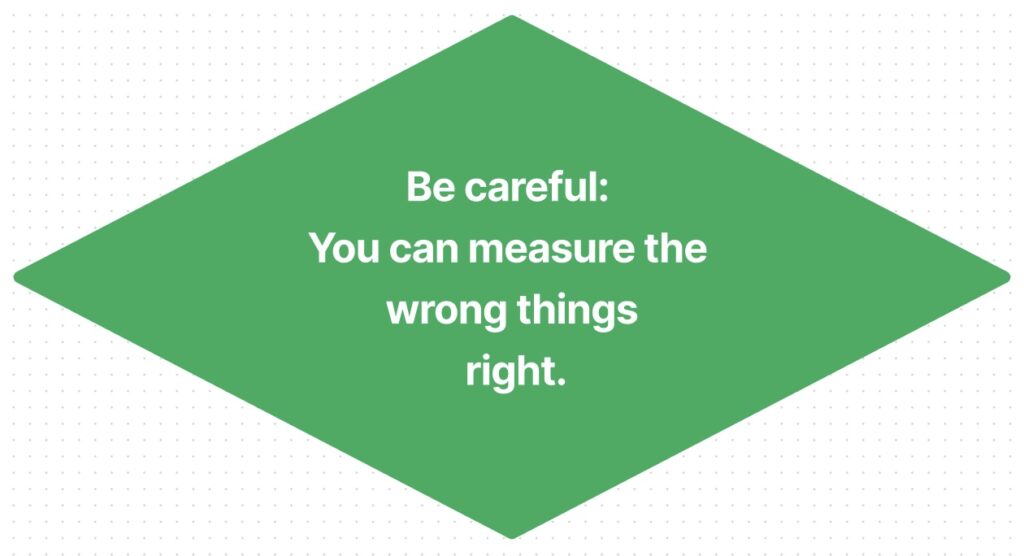
Measuring the Wrong Things Right

You’ve heard the cliche in business meetings “If you can’t measure it, you cannot improve it.” It’s nice to sound smart in a business meeting, but be careful. It maybe time to be an anti-conformist with the cliche use. You can measure the wrong things right.

Be care to not measure the wrong things right.

3 Considerations in Measuring Things Right

Here are 3 considerations on measuring the wrong things right in your business and in life:

1) You can improve things without measurement. You can evaluate periodically and decide are things getting better. For instance you can evaluate whether or not you are becoming a better manager or coach. There aren’t a lot of object measures for improvement on these personal areas of development but by occasionally reflecting and evaluating you know you are getting better. No measurement needed. No wasted energy and resources. Evaluating is enough in some cases.

2) When you do end up measuring a thing, you might actually only be improving the measurement, and not actually be improving the underlying thing. So now you are wasting energy and resources focusing on the wrong thing and not making any real progress. We don’t want to get better a measuring.

3) You can end up measuring the wrong things right. In this case you start steering the business in the entirely wrong direction and make things far, far worse. This is a HUGE issue that is a silent killer of businesses.

Conformity creeps into everything and is the enemy of authentic and real leadership.    We need the courage to think differently in our business meetings and not jump to cliche conclusions. Take a courageous path and not the well trodden pathway that has been portrayed as the road less traveled.  Take the time to reflect and evaluate before you jump into measuring the wrong things right.

Grab some other new #personal and #professional #insights from me here: https://us17.campaign-archive.com/home/?u=d3a271ec25edc892d966d0973&id=3ffc1f5ae4